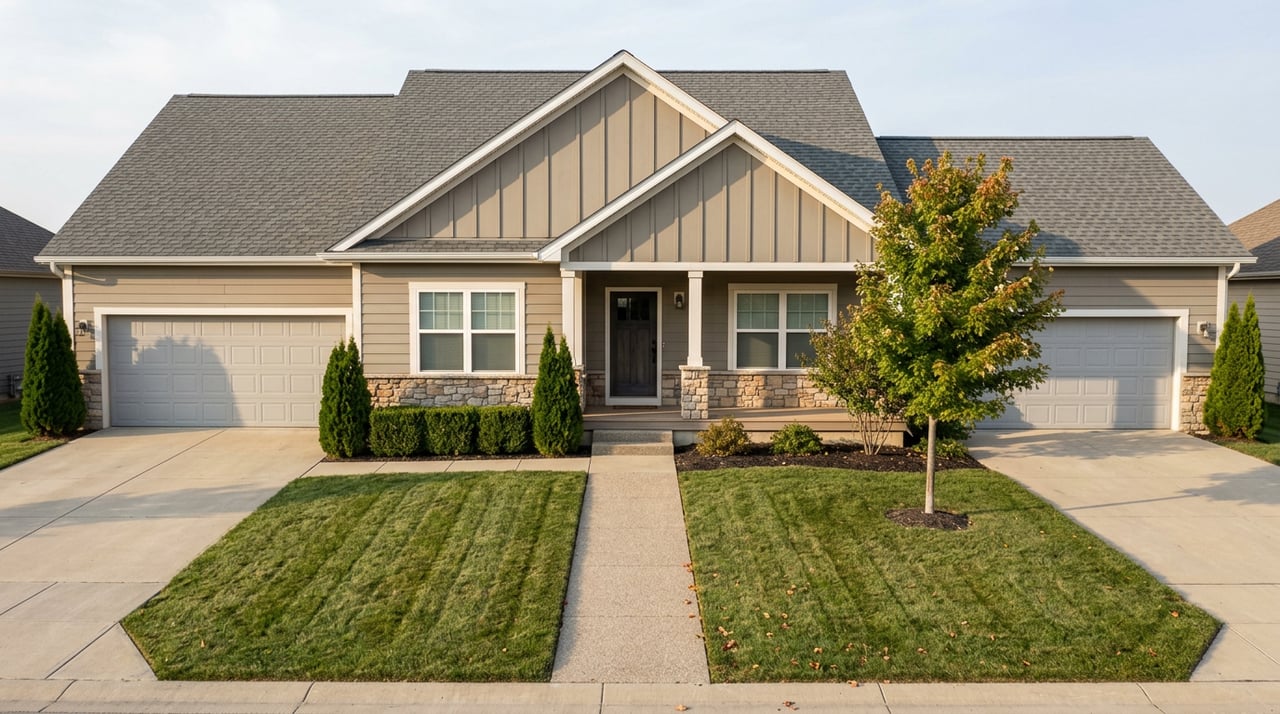
On North Broadway Avenue in Urbana, just off Crystal Lake Park, sit six beige apartment buildings with matching black trim. A sign out front reads University Park Apartments. All 104 units are rentals. Not one of them has an owner living inside.
And yet, according to a June 2026 investigation by the nonprofit newsroom CU-CitizenAccess, every one of those units carries a property tax exemption that Illinois law wrote specifically for people who own and occupy their own homes.
That is not a clerical error. It is a legal workaround, and it is worth understanding before you buy a home or a rental property anywhere in Champaign County, because it explains something a lot of buyers notice but can't quite place: why two homes that look nearly identical on paper can carry very different tax bills.
What the exemption is actually supposed to do
Illinois' General Homestead Exemption knocks a set amount off a property's Equalized Assessed Value, the number your local composite tax rate actually gets applied to. In Champaign County, that reduction runs up to $6,000 off your EAV, which translates to real, if modest, annual savings depending on your local rate. The idea is straightforward: if you live in the house on January 1 of the assessment year and it's your primary residence, you get the break. Landlords, in theory, don't qualify, because the rental unit isn't their primary residence.
That's the theory. Champaign County's practice looks different.
The workaround, and who's using it
Illinois law allows something called a leasehold exemption. If a landlord's lease includes a clause stating that rent will go up or down as property taxes change, the landlord can apply for the homestead exemption on that unit, arguing the tenant effectively bears the tax burden through rent. Approve the application, and a rental property gets taxed as if it were owner-occupied.
CU-CitizenAccess found that roughly 1,400 landlords in Champaign County are granted multiple homestead exemptions each year, more than 3,000 exemptions total, on properties they don't live in. County assessment data pegged the savings at an estimated $1.8 million for tax year 2025. Property management names that show up in that data include Green Street Realty and UP Urbana, and University Park Apartments is one of the specific complexes the report points to by name.
Champaign County Assessor Paula Bates told the newsroom that her office checked with the state's attorney's office and was advised the practice is legal. Nobody disputes that. What's notable is how much of the county's rental stock is running through it, and how long it's been running through it. The same newsroom flagged a similar pattern back in 2015, when about 960 property owners held roughly 3,600 exempted properties for an estimated $2.1 million in savings that year. A decade later, the number of landlords using the loophole has gone up while the total dollar savings has ticked down slightly, which suggests the average value per exemption has shrunk even as more landlords have found the door.
Compare that to McLean County, home to Illinois State University. Its chief county assessment officer, Timothy Jorczak, told CU-CitizenAccess his office processes only about 200 leaseholds against roughly 40,000 total homestead exemptions, a much smaller share than Champaign County's. His explanation was simple: university life is a smaller piece of McLean County's overall footprint than it is in Champaign County, and his office generally prefers the tenant, not the landlord, to be the one paying the tax bill directly. Same state, same law, very different local practice.
Why this matters when you're the one signing a purchase agreement
If you're comparing listings in Champaign, Urbana, or Savoy and you notice the property tax figure on one home looks unusually low for its size and location, this is one of the things worth asking about, especially if the property has been a rental. A tax bill on a listing sheet is a snapshot of last year's exemption status, not a guarantee of what your bill will look like once you own the place.
A few scenarios worth knowing before you write an offer:
- If you're buying a home from an actual owner-occupant, their homestead exemption does not automatically transfer to you. You have to file your own General Homestead Exemption application with the county after closing, or you'll be paying tax on the full assessed value until you do.
- If you're buying a rental property that currently carries a leasehold exemption, that exemption is tied to a specific lease with a specific tax-adjustment clause. It is not guaranteed to survive a change in ownership, tenant, or lease terms, which means the tax line on the current listing may not reflect what you'll actually owe as the new owner.
- If you're comparing two homes with a wide tax gap and neither is obviously explained by size or condition, some of that gap is genuinely just geography. County property records show Savoy carrying one of the higher median tax bills in the county, above $6,000 a year, while a smaller community like Longview sits closer to $1,660, purely a function of which school, park, and library districts overlap a given parcel. Not every gap is the exemption story. But on a property that's been rented, it's a question worth asking rather than assuming.
None of this makes the leasehold exemption improper. It makes it a detail that changes your math, and the kind of detail that only shows up if someone tells you to look for it.
The bigger reason exemptions carry more weight here
Champaign County's effective property tax rate runs noticeably above the national median, with various county-level estimates in 2026 putting it somewhere in the low-to-mid 2% range countywide, and closer to 2.7% once you're inside Champaign city limits and stacking on municipal, park, and library levies specifically. Part of the reason the rate has to run that high traces back to who isn't paying into it at all.
The University of Illinois Board of Trustees is the largest property owner in Champaign County by a wide margin, holding at least 400 properties across more than 7,500 acres. As a public institution, the university is exempt from property tax entirely, a status confirmed on the university's own business and finance pages. That's thousands of acres generating no property tax revenue for the schools, townships, and municipal services that everyone else's tax bill funds. When a big chunk of the map doesn't pay in, the districts have to draw more from what's left, which is one reason the composite rate on ordinary homes in this county tends to run higher than in a similarly sized Illinois county without a flagship university anchoring it.
Layer a landlord exemption loophole on top of an already tax-exempt university footprint, and you start to see why individual tax bills in Champaign-Urbana can vary as much as they do, sometimes for reasons that have nothing to do with square footage or curb appeal.
Frequently asked questions
Is the leasehold exemption illegal? No. Champaign County's assessor has said the practice was reviewed by the state's attorney's office and found to be permitted under current Illinois law, provided the lease includes the required tax-adjustment clause.
I'm buying a home to live in myself. Do I need to worry about any of this? You need to do one specific thing: file your own General Homestead Exemption with the Champaign County Assessment Office after closing. Don't assume the seller's exemption carries over with the deed.
Where do I check whether a specific property currently has an exemption? The Champaign County Assessment Office handles exemption records and applications directly, and its website is the most reliable place to confirm a property's current status before you finalize an offer.
Tax bills are one of the few numbers in a real estate transaction that look simple and rarely are. If you're weighing two homes in Champaign County and the numbers don't quite add up, or you're sourcing a rental property and want to know what your actual carrying costs will look like after closing, that's exactly the kind of question The Tracy Slater Group walks clients through every week. Schedule a free consultation and let's look at the specific parcel, not just the listing sheet.